Physics-Ready Assets and Digital Twins
A reconstructed scene is not yet a world. Photometric reconstruction — a Gaussian-splat map, a mesh, a radiance field — tells you what a place looks like, but a simulator needs to know what it is made of: which surfaces belong to separate objects, where the collision boundaries lie, how heavy things are, how much grip a surface offers. Everything downstream of reconstruction in our stack — differentiable vehicle physics, residual policy learning, closed-loop evaluation — depends on that missing half.
This project sets out to close it. Our goal is to turn reconstructed scenes into physics-ready assets that a physics engine can actually run, and into twins whose behaviour can be checked against the real thing.
Our position on how to get there is deliberate: we will build on the open reconstruction stack rather than reimplement it. Neural reconstruction from real sensor data is now a well-supported problem with strong open tooling, and the research value for us sits in the step after it — binding physical semantics to reconstructed geometry, and validating that the result behaves correctly under contact. The plan below is organized accordingly: the first three stages are frameworks we intend to adopt, and the last three are what we will build on top of them.
What we will build on
-
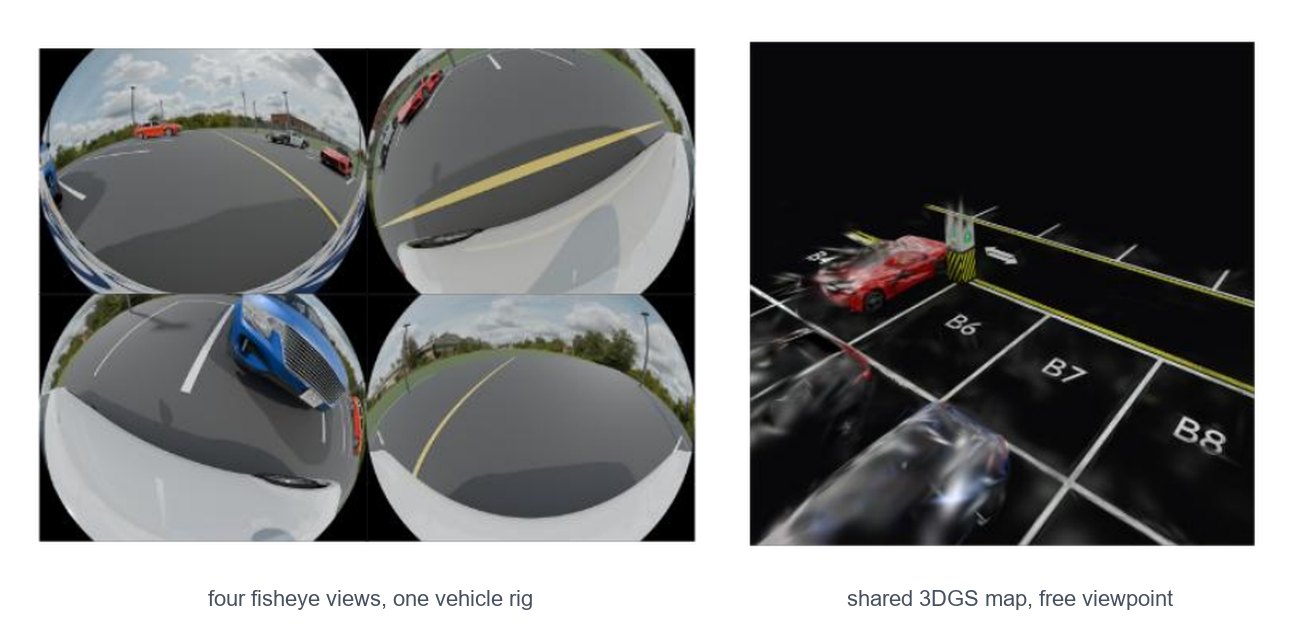
Reconstruction backbone. We plan to adopt NVIDIA Omniverse NuRec as the ingestion and reconstruction layer — a set of 3D Gaussian Splatting libraries that take real camera and lidar data and emit an OpenUSD scene that simulators can load. Its feed-forward variant, Instant NuRec, replaces per-scene optimization with a single forward pass, which matters when the goal is to build many environments rather than one showcase scene.
-
Object-level decomposition. Before mass, friction or articulation can be assigned to anything, the scene has to be separated into instances. We will follow the scale-conditioned grouping line — promptable 2D masks lifted into a consistent 3D grouping over the Gaussian field, as implemented in GARƒVDB — so that “this parked car”, “this kerb”, “this wall” become addressable entities rather than undifferentiated geometry.
-
From splats to surfaces. A Gaussian field cannot be collided against; a surface can. We will use the mesh-extraction path in ƒVDB Reality Capture — rendered stereo pairs, learned depth, truncated signed-distance fusion, sparse marching cubes — to obtain the surfaces from which collision proxies are derived.
What we will contribute
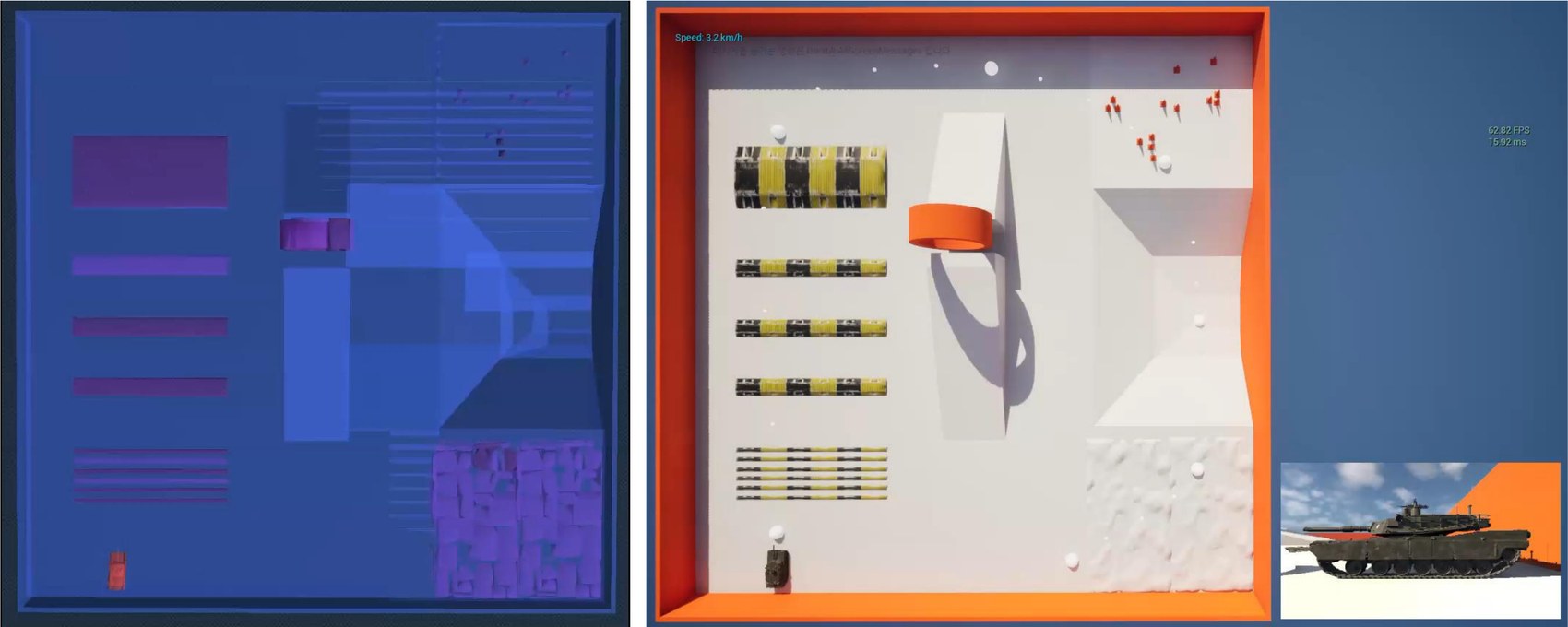
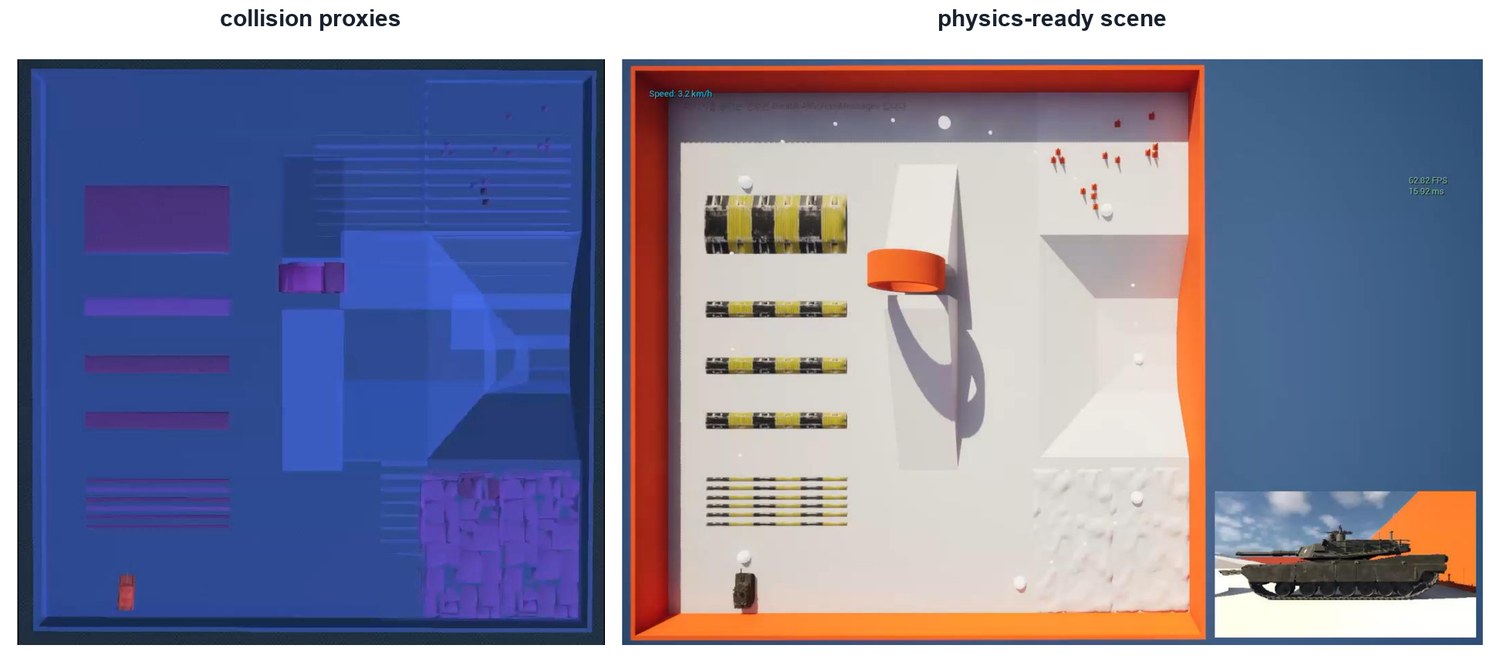
- Explicit collider binding. Visual geometry and collision geometry are kept as separate, explicitly bound layers: convex hulls, height fields and signed-distance volumes are attached to visual assets rather than derived from them at render time. The separation is what lets rendering fidelity and simulation stability be tuned independently — a collision proxy can be coarse and stable while the visual asset stays detailed. It also makes the binding inspectable, which matters more than it sounds: most contact bugs are obvious in a collider view and invisible in a rendered one. This part is already running in our in-house engine, and the work ahead is to drive it from reconstructed scenes rather than authored ones.
-
Physical property estimation. Geometry is only half of “physics-ready”. Mass, inertia, friction and restitution have to be attached to each instance, and none of them can be read off a photograph. We will estimate them by inversion instead — replaying observed motion in a differentiable simulator and back-propagating the discrepancy into the physical parameters, which is the same machinery described in our Real2Sim & Sim2Real work.
-
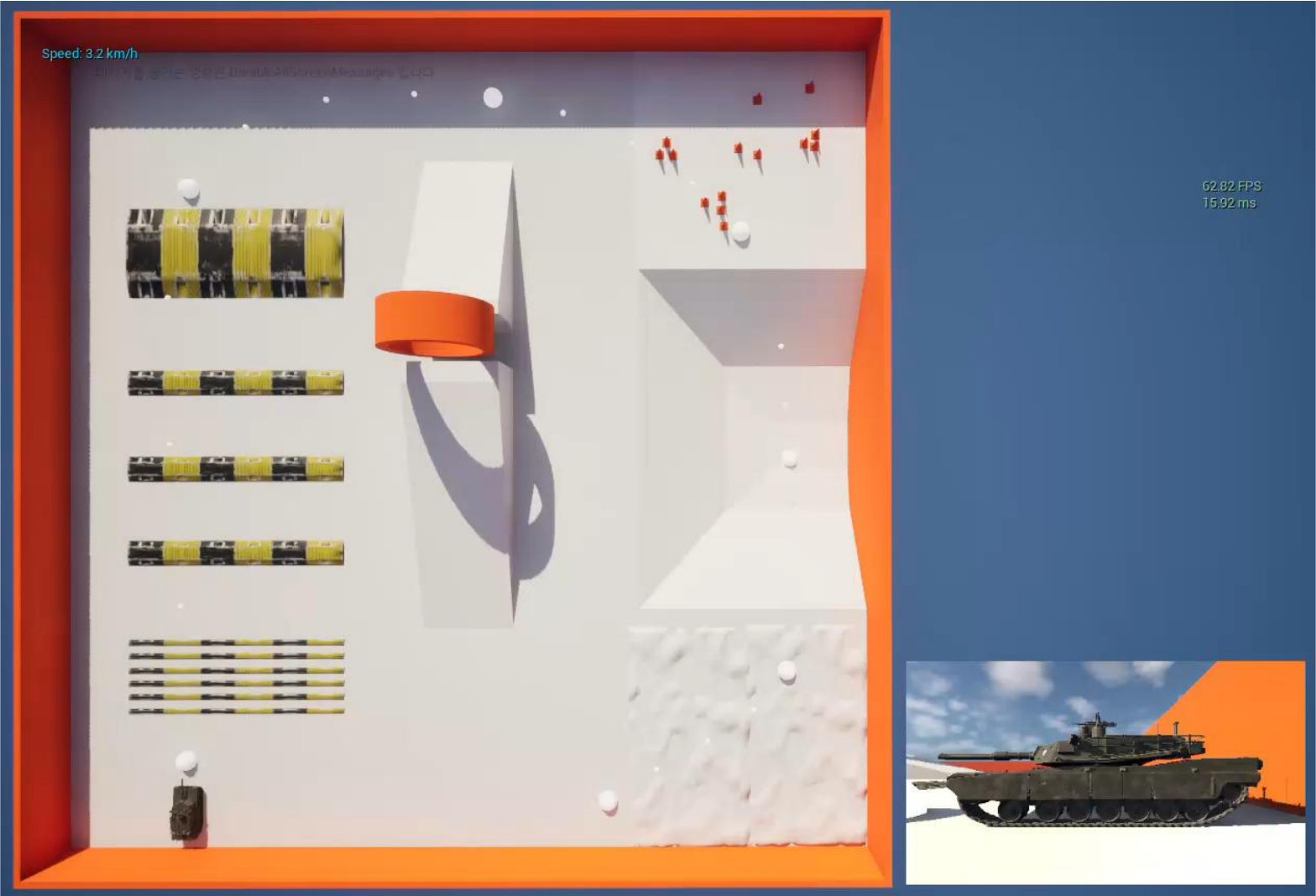
Validation by driving. A twin is only trustworthy to the extent that it has been driven. Each reconstructed environment will be exercised on a test course — slopes, steps, drops, contact-rich clutter — and accepted only when a vehicle behaves in it the way it does in the physical world. This is also how we intend to catch collider errors, which no rendering metric reports.
Where the open stack currently stops
It is worth being precise about the gap this project addresses, since it is easy to assume reconstruction tooling already solves it. Reconstruction output is, in the general case, visual geometry with no inherent collision properties; collision surfaces are available only in specific depth-based workflows, and even there the physical semantics — which mesh is a movable object, what it weighs, how it grips — are still assigned by hand. Automating that assignment, and validating it under contact, is the part we are taking on.
programming experience
Python, PyTorch, CUDA, 3D Gaussian Splatting, OpenUSD, physics engines (PhysX / Genesis), mesh processing and collision proxy generation, Isaac Sim